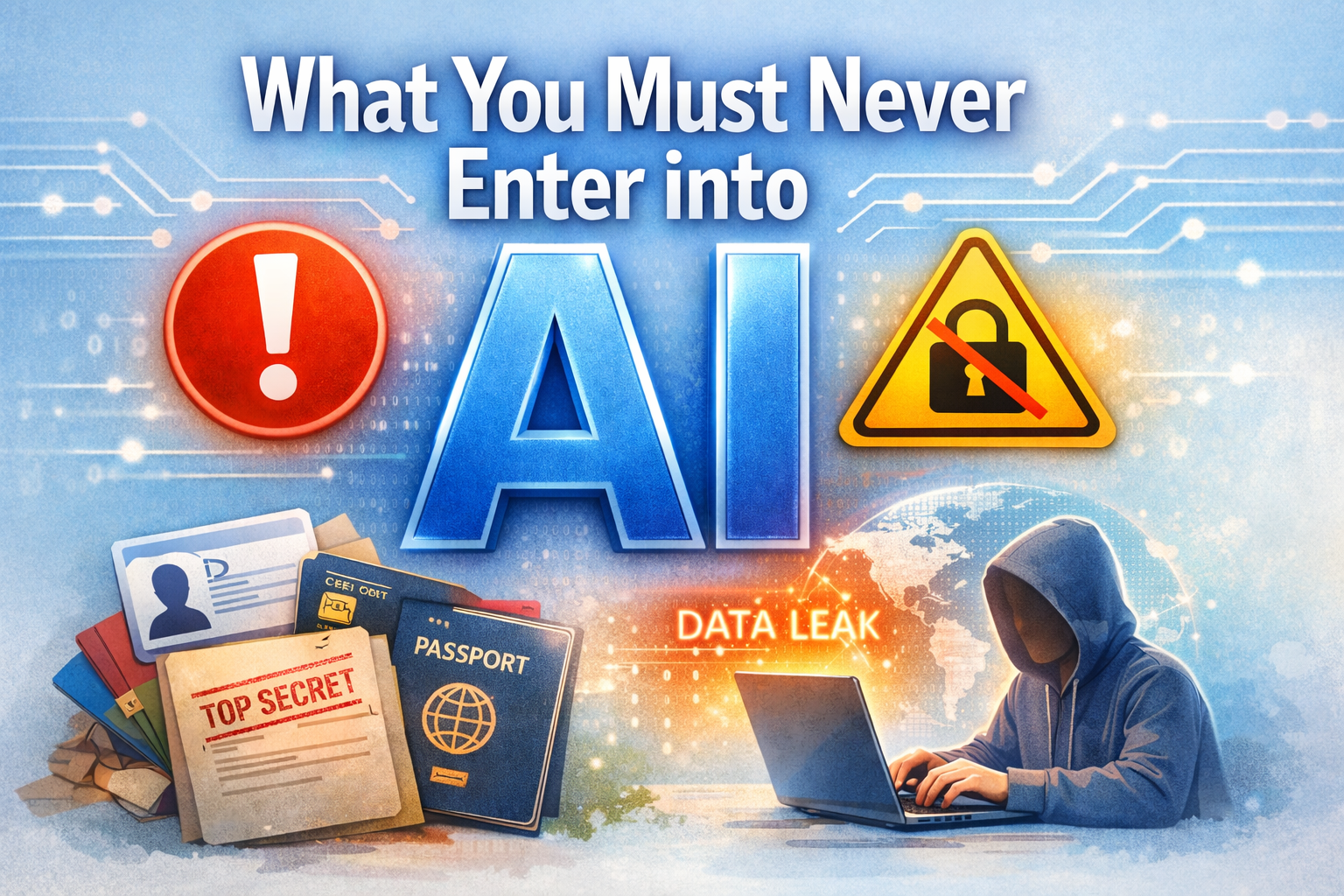
A Practical Safety Guide for Responsible AI Use
📌 Table of Contents
🔹 Why Input Safety Matters in AI
🔹 Personal and Privacy Information You Must Not Enter
🔹 Company Confidential and Security Information
🔹 Copyrighted and Unpublished Works
🔹 Misuse, Crime, and Harmful Purposes
🔹 What To Do If You Already Entered Sensitive Information
🔹 What You Can Safely Enter into AI
🔹 How Not to Miss Opportunities by Being Too Defensive
🔹 Simple Rules to Encourage Safe AI Use in Organizations
🔍 Overview
In this lesson, you will learn what information should never be entered into AI systems, why it is dangerous, real-world examples of problems, and what to do if you already made a mistake.
You will also learn what information is safe to use, so you can use AI actively without unnecessary fear.
📖 Lesson Start
Understanding AI Safety Through Dialogue
🗣 (S)
I hear people say, “Do not put personal data into AI.”
But honestly, I do not really understand why.
Is AI that dangerous?
🎓 (T)
That is a very good question.
AI itself is not evil, but how we use it matters a lot.
AI processes information on external servers, and once data is entered, you cannot fully take it back.
It is about privacy, contracts, law, trust, and responsibility.
Let us go step by step.
🔹 Why Input Safety Matters in AI
🗣 (S)
If AI is just answering my questions, why does input matter so much?
🎓 (T)
Because AI does not understand context, ownership, or permission.
It cannot tell whether information is confidential, personal, or protected by law.
🎓 (T)
Think of AI like a very powerful assistant who works in a public office.
It is smart, fast, and helpful—but not not a guardian of secrets.
🔹 Personal and Privacy Information You Must Not Enter
❌ Examples of Information You Must Never Enter
- Full name, home address, phone number, email address
- National ID numbers, social security numbers, insurance numbers
- Passport numbers, driver’s license numbers
- Bank account details, credit card information
- Medical records, health conditions, genetic data
- Religious beliefs, political opinions, psychological conditions
❓ Why This Is Dangerous
🎓 (T)
AI processes conversations on external systems.
Depending on settings and service terms, data may be logged for quality analysis.
🎓 (T)
Once you enter personal data, you lose full control over it.
⚠️ Possible Risks
- Identity theft
- Fraud and impersonation
- Privacy violations
- Violations of international data protection laws (such as GDPR)
📉 Real Examples
- Medical staff entered patient data → policy violations and investigations
- Customer support staff entered real names and contact details → internal audits
🔹 Company Confidential and Security Information
❌ Examples You Must Not Enter
- Non-public project names or contracts
- Client lists and partner information
- API keys, passwords, encryption keys
- Internal system architecture and security design
- Business strategies and unpublished financial documents
- Proprietary source code
⚠️ Risks
- Information leaks
- Insider trading risks
- Loss of trust from partners
- Legal claims and contract termination
📉 Real Examples
- Developers entered confidential code → company banned AI usage completely
- Employees summarized secret documents → disciplinary action
🔹 Copyrighted and Unpublished Works
❌ What Not to Enter
- Unpublished research papers
- Draft novels or scripts
- Technical designs and blueprints
- Legal contracts and sensitive documents
🎯 TIP: Public Wall Rule
Ask yourself:
“Would I put this text on a public notice board?”
If the answer is no, do not enter it.
⚠️ Risks
- Loss of intellectual property
- Copyright violations
- Early leakage of business ideas or research results
📉 Real Examples
- Research papers edited with AI → rejected by journals
- Full contracts uploaded → legal risk warnings
🔹 Misuse, Crime, and Harmful Purposes
❌ Forbidden Inputs
- Instructions for illegal activities
- Hacking or fraud methods
- Hate speech or violent content
- Disinformation or propaganda requests
🎓 (T)
Most AI services clearly prohibit these uses.
Activity logs can be reviewed, and accounts may be permanently suspended.
🔹 What To Do If You Already Entered Sensitive Information
🗣 (S)
What if someone already made a mistake?
🎓 (T)
Then speed matters.
✅ Step 1: Stop Further Damage
- Delete the chat immediately
- Change passwords and API keys
- Freeze or reissue cards and accounts if needed
✅ Step 2: Check AI Settings
- Turn on “Do not use chats for training”
- Delete chat history if possible
✅ Step 3: Share and Report Internally
- Report to supervisors or data protection officers
- Create education and prevention systems
- Assume people may hide mistakes—design rules accordingly
🔹 What You Can Safely Enter into AI
🎓 (T)
AI safety does not mean “never use AI.”
It means use it wisely.
✅ Safe Examples
1. Abstract and Generalized Information
- Fictional companies (Company A, Client X)
- Rounded numbers (“several thousand dollars”)
- Common industry challenges
Use cases:
- Process improvement ideas
- Draft customer responses
2. Brainstorming and Early Ideas
- Business concepts not yet defined
- Naming ideas and outlines
- Questions with no single correct answer
🎓 (T)
Ideas alone are rarely valuable.
Execution, market knowledge, and improvement create real value.
3. Public or Soon-to-Be Public Content
- Published blog posts
- Press release drafts (without secrets)
- Public scripts and articles
4. Learning and Training
- Fictional case studies
- General law, accounting, IT questions
- Training quizzes and simulations
🔹 How Not to Miss Opportunities by Being Too Defensive
🗣 (S)
Is it possible to be too careful?
🎓 (T)
Yes, very much so.
🚫 Risks of Over-Restriction
- Slower thinking
- Fewer ideas
- Less learning for younger staff
- Falling behind competitors
🎓 (T)
Remember:
- Ideas are not value—execution is
- AI supports thinking, but humans decide
- Responsibility always stays with people
🔹 Simple Rules to Encourage Safe AI Use in Organizations
✅ Recommended Approach
- Do not ban AI—create guidelines
- Accept gray zones
- Abstract data when unsure
📜 Simple Internal Rules
- Do not enter personal or confidential data
- Replace real names and numbers with placeholders
- Encourage AI use for drafts and brainstorming
- Humans must review all final outputs
🛠 Practice
👉 Take one real task you do at work.
Rewrite it in abstract form (no real names, no exact numbers).
Then ask AI for ideas or improvement suggestions.
🎓 Comprehension Quiz
Which information is safe to enter into AI?
A. A customer’s real phone number
B. A fictional case with abstract numbers
C. A company’s API key
📌 Summary
- AI processes data externally and cannot judge confidentiality
- Personal, confidential, and unpublished information must not be entered
- Mistakes require immediate action
- Safe AI use balances protection and active utilization
- Clear rules enable growth, not fear
📝 Quiz Answers
Correct answer: B