📌 Table of Contents
🔹 What Is Physical AI? A Topic Everyone Is Talking About
🔹 Why Physical AI Was Not Possible Before
🔹 Why Physical AI Is Becoming Possible Now
🔹 What Physical AI Can and Cannot Do Today
🔍 Overview
This lesson explains Physical AI as a recent AI trend, not as a technical subject to master, but as a topic to understand calmly.
We look at why it was so hard in the past, why it is becoming possible now, what already works, and what still does not.
📖 Lesson Start
🔹 What Is Physical AI? A Topic Everyone Is Talking About
🗣 (S)
I keep hearing the term Physical AI. Is this something totally new? Is it about robots taking over?
🎓 (T)
That is a very common reaction. Physical AI is not about AI suddenly becoming smarter than humans.
It is about AI entering the real, physical world and interacting with it using bodies like robots, machines, or devices.
Until recently, most AI lived in digital spaces.
It worked with text, images, numbers, or sounds on screens.
Physical AI is different because it must deal with real objects, real gravity, real friction, and real mistakes.
This is why Physical AI is being talked about so much right now.
Not because it is perfect, but because it is finally starting to work at all.
🔹 Why Physical AI Was Not Possible Before
🗣 (S)
But robots have existed for decades. Why was this impossible until now?
🎓 (T)
In one sentence, the reason is this:
Movements that feel normal to humans are extremely hard for machines.
The real world is messy.
Every object is slightly different in shape.
Positions are never exactly the same.
Unexpected things always happen.
In the past, robots could only move if humans explained everything in detail.
For example:
- “Move your hand 3 centimeters to the right.”
- “Rotate the wrist by 5 degrees.”
- “Apply force level 0.2.”
To a human, picking up a single flower feels simple.
To an old robot, that single action required hundreds or even thousands of instructions.
And if something changed just a little:
- The table was higher
- The object was softer
- The angle was different
Everything had to be rewritten from the beginning.
🗣 (S)
So even small changes broke everything?
🎓 (T)
Exactly.
The real world was simply too complex.
AI could not keep up.
That is why Physical AI stayed mostly in labs and factories with very strict conditions.
🔹 Why Physical AI Is Becoming Possible Now
🗣 (S)
So what changed? Why are people confident now?
🎓 (T)
There are three key reasons, and they are surprisingly simple to understand.
First: Virtual Simulation Became Powerful
In the real world, failure is expensive.
A robot can break itself, damage objects, or hurt people.
In virtual environments, none of that matters.
AI can now:
- Fail millions of times
- Learn at high speed
- Improve without real-world cost
The AI trains first in a virtual world, similar to a realistic video game.
Only after it becomes stable does it move into the real world.
This changed everything.
Second: AI Can Calculate Fine Movements by Itself
🗣 (S)
Does that mean humans stopped giving detailed commands?
🎓 (T)
Yes, that is the big shift.
Before:
Humans controlled every step.
Now:
Humans give a goal, not instructions.
For example:
“The goal is to pick up the flower.”
The AI figures out:
- How to move the fingers
- How much force to use
- How to adjust if something slips
This is much closer to human intuition than rigid programming.

Third: Computing Power Increased Dramatically
In the past, AI could only think once per second, or even slower.
Now, AI can:
- Recalculate hundreds of times per second
- Detect tiny mistakes instantly
- Adjust movement in real time
This allows reactions like:
- “It is slipping.”
- “This angle is wrong.”
- “I need to slow down.”
🗣 (S)
So it can correct itself while moving?
🎓 (T)
Exactly. That ability is essential for physical interaction.
🔹 What Physical AI Can and Cannot Do Today
🗣 (S)
So what already works in real life?
🎓 (T)
Physical AI is already practical in limited environments.
Examples include:
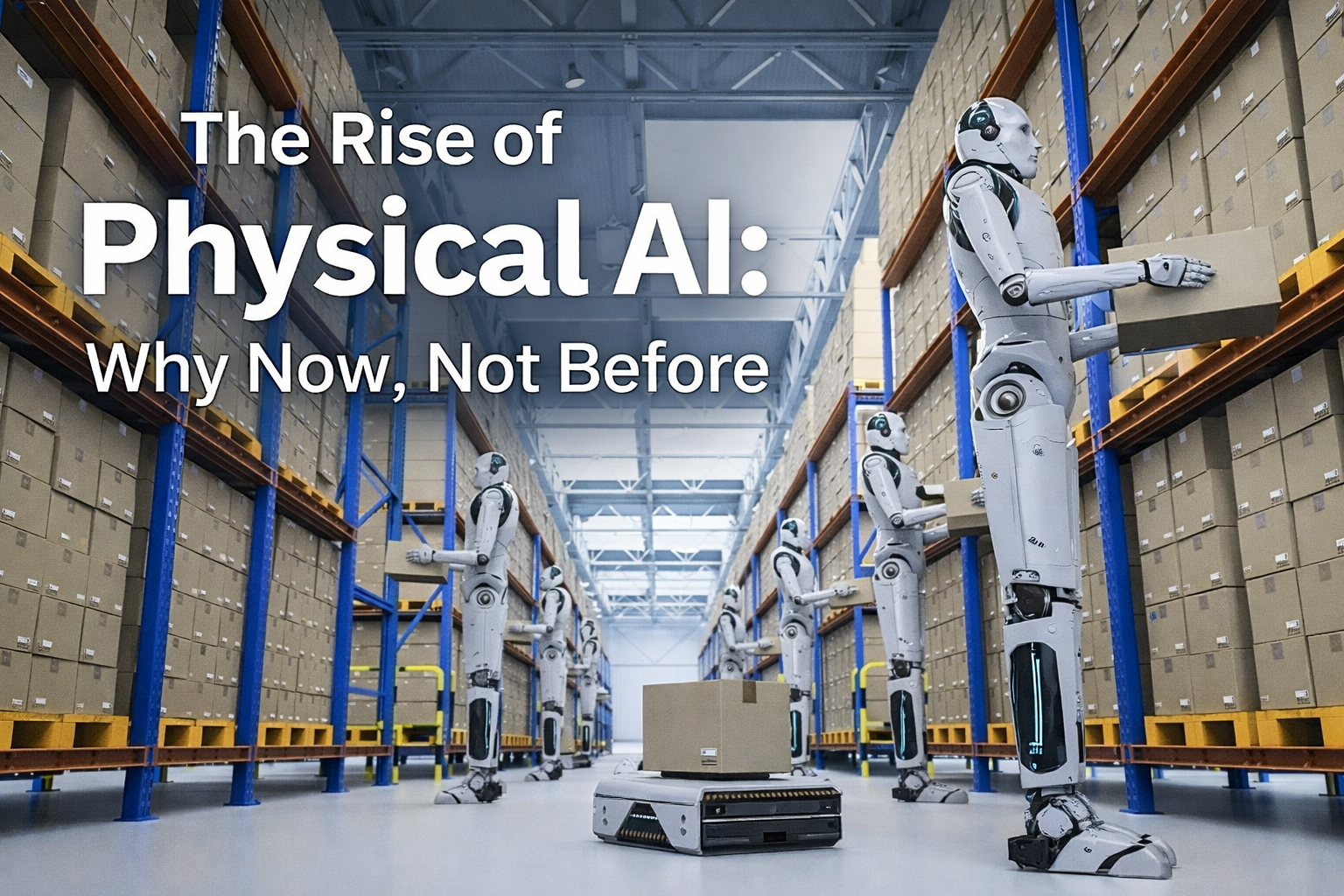
- Moving goods in warehouses
- Repeating tasks in factories
- Working in dangerous locations
- Autonomous movement in controlled spaces
However, there are clear limits.
Physical AI still struggles with:
- Soft or flexible objects like clothes or cables
- Reading human emotions or context
- Improvising in unexpected social situations
- Making decisions with ethical responsibility
🗣 (S)
So humans are still needed?
🎓 (T)
Very much so.
Especially where responsibility, judgment, and care are involved.

🛠 Practice
👉 Think about your own work or daily life.
Write down:
- One task that is dangerous, repetitive, or physically hard
- One task that requires judgment, empathy, or responsibility
This helps you clearly see where AI fits and where humans remain essential.
🎓 Comprehension Quiz
Understanding Check (Choose One)
Question:
Why is Physical AI becoming possible now?
A. Because robots suddenly became intelligent like humans
B. Because virtual simulation, self-adjusting AI, and computing power improved
C. Because humans stopped controlling machines entirely
📌 Summary
- Physical AI means AI interacting with the real world
- The real world was too complex for old AI systems
- Virtual simulation allows safe and massive learning
- Modern AI adjusts movements by itself toward a goal
- Computing power enables real-time correction
- Physical AI works best in controlled environments
- Human judgment and responsibility are still essential
📝 Quiz Answers
Correct answer:
B
Physical AI did not suddenly surpass humans.
It has finally begun to approach what humans consider “normal movement.”